


The idea is to reduce exposure to stocks and bonds and allocate a larger portion to other assets. Those alternatives can take many forms. Some investors turn to hard assets or digital stores of value such as gold or cryptocurrencies. Others look to private markets, including private equity, private debt, and real estate.
Then there’s a third category that often gets less attention but is more accessible: hedge fund-like or market-neutral strategies designed to generate returns with lower correlations to traditional assets.
Since early 2019, regulatory changes in Canada have expanded access to liquid alternatives in both mutual funds and ETF format. Today, Canadian investors have a small but growing set of options.
Using the Cboe Canada ETF screen, you can currently find six market neutral ETFs available, with assets ranging from a few million dollars for the Fidelity Market Neutral Alternative Fund (FMNA) to more than $500 million for larger offerings like the Picton Market Neutral Equity Fund (PFMN).
Time helps. Many of these funds were introduced immediately after regulatory changes, meaning we now have several years of performance data to look back on. That includes times of market stress like the March 2020 COVID-19 crash and the 2022 bear market. The question you should ask yourself now is, “Have these strategies delivered on their promise of diversity?”
To answer that, we’ll take a look at how market-neutral ETFs work, examine the three largest options available in Canada, and review what the data says about their role relative to common stock and bond allocations.
What is the strategy of market neutrality?
A market neutral strategy falls under the broad category of alternative investing, meaning it goes beyond simply buying and holding stocks or bonds. Instead of relying on markets to rise over time, these strategies aim to generate returns regardless of where the market is headed.
The reason this structure exists is that stock returns are driven by more than just the company’s fundamentals. Broader forces such as interest rate changes, economic growth, credit conditions, and general market sentiment can move large groups of stocks in the same direction. Even a strong company can shrink if the broader market is under pressure, for example.
Article Continues Below Advertisement
X
Market-neutral strategies aim to minimize that effect. By balancing long and short positions, they try to adjust for broader market movements and isolate specific sources of risk and return. For example, a manager may have strength in a particular sector, such as US energy, but be aware that a broader market decline may still bring those stocks down. If so, they may go long in selected energy companies while missing the broader market index to hedge against the risks of the general markets.
The aim is to provide an investment with a beta close to zero, meaning it is less sensitive to overall market movements. If successful, the returns generated will come primarily from the relative performance of long and short positions rather than the market rising or falling.
A closer look at market neutral ETFs
One thing to note about market neutral strategies is the degree of discretion involved. These are not rule-based index products. Portfolio managers make active decisions about what to buy and what to short, often supported by multiple ownership models. The details of those models are not fully disclosed, which can make them feel like a “black box” to investors. That said, ETF providers still provide a general outline of how their strategies work.
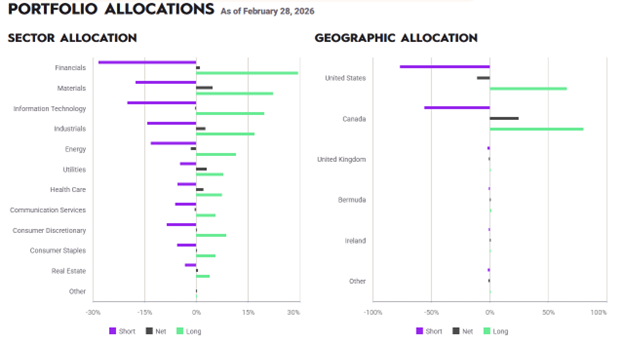
Take PFMN, the largest Canadian market-neutral ETF. It uses 100% long equity exposure and 100% short equity exposure. The goal is to minimize market movements and keep the overall beta close to zero, meaning that returns should be largely independent of the broader equity market.
The fund provides transparency about its long and short exposures, including sector and geographic differences between the two sides of the portfolio.
Source: Picton Investments
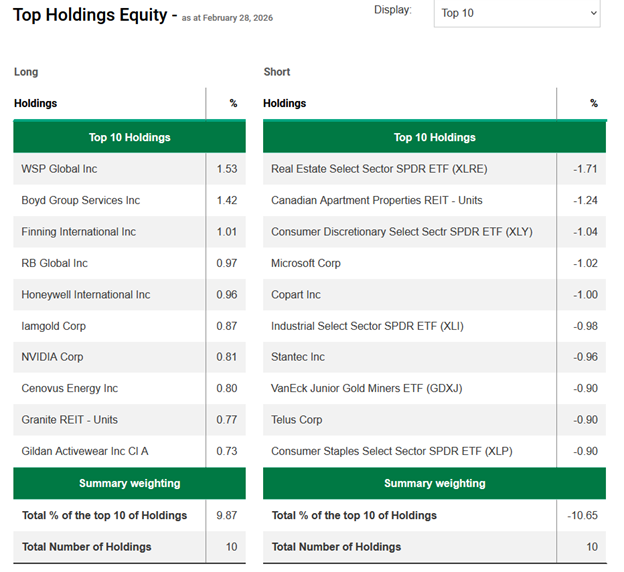
A similar strategy can be seen in Desjardins Alt Long/Short Equity Market Neutral (DANC), which also uses a long/short equity approach designed to limit market exposure.
Source: Desjardins