

If you read this column regularly you will know that this is not surprising for two reasons. First, the cyclical peaks of BTC are usually at the end of the year following the decrease of BTC (2024 in this case). And secondly, because BTC cyclical crashes have historically been over 50%.
However, BTC investors were encouraged by its resilience in the first month of the US-Israel-Iran war when the commodity outperformed the stock market or gold. In fact, in February and March of 2026, BTC had a big run from $63,000 to $81,000. This, unfortunately, was short-lived as BTC quickly retraced its steps until reaching around $60,000 in early June 2026.
Will BTC explode throughout 2026? More on that below.
What can we expect from BTC this year?
Although investment markets, including BTC and crypto, are often unpredictable, there are certain historical patterns that can help guide how we see the market developing. At this time, the main historical pattern that can keep investors focused is the following.
Historically, BTC has fallen almost one year after its peak. I wrote about this a few months ago in this very column. To be sure, there is no guarantee that this pattern will repeat itself, but if it does you can expect the market to drag for several months before the bear market ends in late 2026. Keeping this larger context in mind, it is not surprising that BTC has not been able to hold the gains it made in Feb-Mar this year.
The best crypto platforms and apps
We have ranked the best crypto exchanges in Canada.
In the last two market cycles, BTC prices moved slowly—trading low to low—from the second half of the year to December of that year. The same pattern played out in 2022 and 2018. While I think this is an important data point for crypto investors, we are all ultimately at the mercy of what happens in the US-Iran war and its effects on the markets. At that point there may be something to be excited about, as described below.
What does the end of US-Iran mean for BTC
As I have explained in previous editions of this column, the biggest factor moving the market these days is the US-Iran war. Simply put, war is very disruptive and reduces the supply of oil around the world. This causes the price of oil to rise, causing global inflation—because oil (in one form or another) is a major input cost for all sectors of the economy.
As of June 18, 2026 the US and Iran have reportedly agreed to a 60-day ceasefire extension in which, widely reported, the Strait of Hormuz will be opened and Iran will gain access to nearly half of the $24 billion in frozen assets. The agreement allows 60 days for negotiations on the core issues that allegedly led to the war in the first place. So, while I welcome this exemption from war—especially for the people at the heart of the suffering—I’m not entirely convinced that the deal won’t be destroyed by the US, Israel, or Iran.
Article Continues Below Advertisement
X
Having said that, which is a good sign for investors, the oil market has seen a big relief. The price of NYMEX crude has fallen about $8 (10%) in the past few days since the deal was announced and about $30 (30%) since May 19, 2026, as the one-month NYMEX price chart below shows.
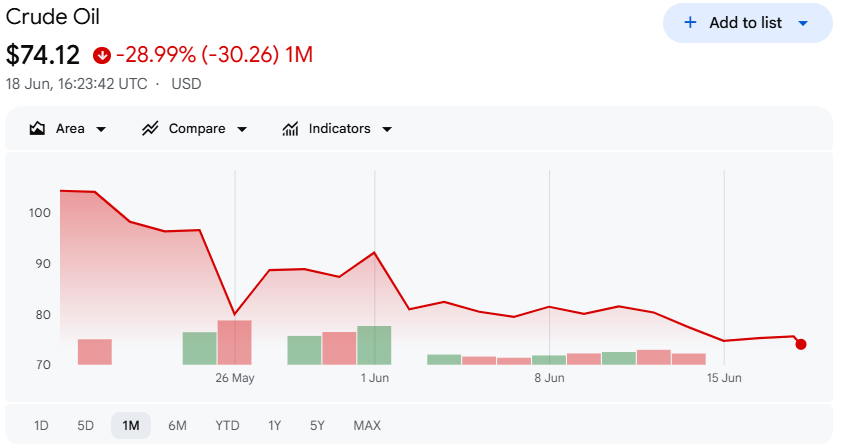
Source: Google Financials as of Jun. 18, 2026.
Can BTC benefit after this good geopolitical news? Yes, as long as the reduction in oil prices significantly reduces the fear of higher inflation and associated higher interest rates. However, whether or not this plays out depends on the (potentially fragile) success of detente—and the perception that new Kevin Warsh, the new Chairman of the United States Federal Reserve, is taking interest rates.
Crypto price fluctuations are common
Cryptocurrencies including BTC, ETH, XRP, SOL, BNB, and others are highly speculative and volatile assets subject to significant price movements. Even stablecoins, which appear to be “safe,” can be dangerous if they are not adequately backed by real-world assets.
Investing in bitcoin and other crypto coins has significant market, technical, and regulatory risks. Invest in crypto only if it fits your broad investment goals, horizon, and risk profile, and always be on the lookout for crypto scams.
Get free MoneySense financial tips, news and advice in your inbox.
Read more about crypto: